Content note This page describes an accident in which nine people died.
United Airlines Flight 811 · Honolulu to Sydney, via Auckland
Flight 811
24 February 1989
On 24 February 1989, soon after United Airlines Flight 811 took off from Honolulu, its forward cargo door opened in flight. Stuart was on board. This page sets out what the official record shows, what Stuart remembers of that night, and how it shaped the work he went on to do. It is told plainly, in memory of the nine passengers who did not come home.
What the record shows
The night
- 01:52:49 HST Flight 811 is cleared for takeoff from Honolulu on runway 8R.NTSB AAR-92/02, §1.1
- 02:09:09 HST The cockpit voice recorder picks up a loud bang. The forward cargo door has separated from the airplane, and the cabin suddenly loses its pressure.The airplane was climbing between 22,000 and 23,000 feet. §1.1, §1.11
- 02:34 HST The airplane has turned back and landed at Honolulu, on runway 8L. The crew tells the tower the airplane has stopped and the evacuation has begun.§1.1
Times are Hawaii Standard Time, from the National Transportation Safety Board’s Aircraft Accident Report NTSB/AAR-92/02, adopted 18 March 1992.
Aboard
- Flight crew
- 3
- Cabin crew
- 15
- Passengers
- 337
- In all
- 355
Of everyone on board, 346 survived. Nine passengers were lost.
The airplane was a Boeing 747-122, registration N4713U. Source: NTSB AAR-92/02, Executive Summary and §1.1.
Stuart’s first public account · 4 December 2012
In his words
Twenty-three years after the flight, Stuart wrote it down for the first time, in a letter explaining why he had started Cylance. The passages below are his own words from that letter, unedited except where a cut is marked.
-
Settling in
“I settled into my aisle seat … and took my shoes off, anticipating sleeping most of the long flight to New Zealand (the stopover on our way to Sydney). As the plane lifted off and made its climb out of Honolulu I tried to doze off. In the seats on my left were my mother and younger brother.”
Why Cylance? · 4 December 2012 -
The two children
“As I looked out the window I saw two children traveling alone completely confused and scared beyond words. My helplessness made it more painful, I could not offer them any solace or hope.”
Why Cylance? · 4 December 2012 -
The handshake
“I looked to the passenger across the aisle from me, a man I had never met and sitting next to the children traveling alone, as he extended his hand to shake mine and said ‘It’s been nice knowing you.’ After reluctantly shaking his hand my brain was instantly flooded with the concept everyone else was already thinking… I am going to die, aren’t I?”
Why Cylance? · 4 December 2012 -
The realization
“I wish I could say that my life flashed before me but it didn’t. Sure I regretted many things I did or did not do but it wasn’t a flash, it was a revelation – of all the missed opportunities, the squandered challenges, and the missed loves.”
Why Cylance? · 4 December 2012 -
The landing
“There were many stories of heroism and heroine-ism that I will share with you another time but when we landed safely … no one knew how we landed safely not even the pilot.”
Why Cylance? · 4 December 2012 -
The call
“In the months following the flight, I was given the rare opportunity to talk to the Captain of our flight, Captain David Cronin, who was just two flights from mandatory retirement with United. As he spoke to me over the phone from his home in Lake Tahoe I had but one question I had to ask him ‘How did you get us back safely?’”
Why Cylance? · 4 December 2012
National Transportation Safety Board · AAR-92/02
The cause
§3.2 · Probable causeVerbatim
“The National Transportation Safety Board determines that the probable cause of this accident was the sudden opening of the forward lower lobe cargo door in flight and the subsequent explosive decompression. The door opening was attributed to a faulty switch or wiring in the door control system which permitted electrical actuation of the door latches toward the unlatched position after initial door closure and before takeoff. Contributing to the cause of the accident was a deficiency in the design of the cargo door locking mechanisms, which made them susceptible to deformation, allowing the door to become unlatched after being properly latched and locked. Also contributing to the accident was a lack of timely corrective actions by Boeing and the FAA following a 1987 cargo door opening incident on a Pan Am B-747.”
The warning had come two years earlier, on another airline’s 747. Read in order, the record below is a chain of chances to find and fix this door problem in time: an earlier incident, a required fix, a repair date already set for this airplane, and a simple way to see the latches that no one was required to use.
-
10 March 1987
A Pan Am 747’s cargo door opens in flight
Pan Am flight 125, from London to New York, has trouble keeping the cabin pressurized and returns to London. When the airplane is examined on the ground, the forward cargo door is found open about 1½ inches along the bottom. In plain terms, the latches were open, but the handle that locks them was closed and the cockpit’s cargo door warning light was off. The door was not secure, and the warning light did not show it.
“…with the latch cams unlatched and the master latch lock handle closed. The cockpit cargo door warning light was off.”
NTSB AAR-92/02, §1.17.1
-
13 May 1988
The FAA makes the fix mandatory: AD 88-12-04
After the Pan Am incident, in April and August 1987, Boeing sent airlines two notices about the cargo door, called alert service bulletins. The FAA then made their fixes a legal requirement with an Airworthiness Directive, AD 88-12-04. Airlines had to inspect the mechanisms that lock the door’s latches within 30 days. Within 18 or 24 months, depending on the 747 model, they also had to add steel plates, called doublers, to strengthen the lock sectors: the parts that lock the latches in place.
The report gives two dates for the directive. Section 1.6.8 gives the issue date as 13 May 1988. The analysis in section 2.7 cites 1 July 1988: “nearly 16 months from the date of the Pan Am Incident.”
-
April 1989
The fix for this airplane was on the calendar
“According to UAL, N4713U was scheduled for completion of the terminating action in April 1989, when the airplane was scheduled for other heavy maintenance.”
“Terminating action” means the permanent fix the directive called for: the steel doublers on the lock sectors. That work had not yet been done on this airplane, and it was not yet required, because the legal deadline was January 1990. Flight 811 flew on 24 February 1989, weeks before the work was scheduled.
NTSB AAR-92/02, §1.6.8
-
The door itself
Eight small windows that no one was required to check
“The B-747 cargo door has eight (8) view ports located beneath the latch cams for direct viewing of the position of the cams by means of alignment stripes. Procedures for using these view ports for verifying the position of the cams were not in place or required by Boeing, the FAA, or UAL.”
NTSB AAR-92/02, §1.6.2
“After years of investigation, we learned that the event wasn’t a random act of God. This wasn’t bad luck. This was a simple multi-system failure. A chain reaction of design flaws, preventable mistakes. An ignored warning. A faulty backup latching system.”
Stuart McClure · The Gift of a Second Chance
Captain David Cronin
The captain
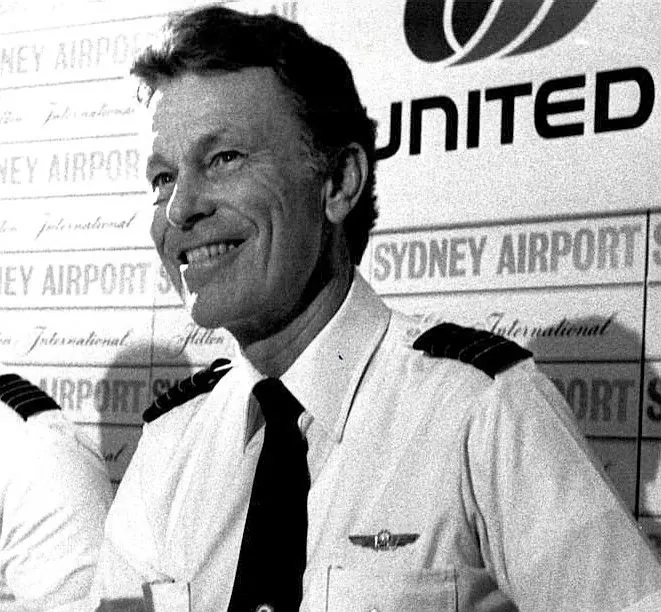
Months later, Stuart reached the captain by phone and asked him how he had brought them home. This is the answer as Stuart recalled it in 2012.
“I don’t know, Stuart.”
“When we landed, the engineers on the ground took the flight data and punched it into our computer model simulations exactly as it was during that flight and with well over 200 simulations modeled, they all crashed in the water or on land. So no, I truly don’t know how we all made it back. I simply cannot explain it.”
Captain David Cronin, as Stuart recalled him · Why Cylance? · 2012
In the captain’s telling, every computer simulation of that flight ended in a crash. Yet the crew found a way to bring the airplane back to Honolulu.
A life’s work
What it became
“Tragedy = Passion.”
Stuart McClure · Why Cylance? · 4 December 2012
“I was given a present beyond words that day: a life’s passion. To find and fix the problems introduced by technology to prevent bad stuff from happening to innocent people. That is my passion. That is our mission. That is what we will achieve.”
Why Cylance? · 4 December 2012
Later, in his memoir
“Surviving that day didn’t just give me a second chance. It burned a mission into my soul. It wasn’t a choice anymore. It wasn’t a career path. It was a moral imperative. My purpose was to find the faulty latches of the world, the weak points, the hidden flaws, the ignored warnings, and fix them before they could tear another hole in someone’s life.”
Stuart McClure · The Gift of a Second Chance
Remembering
Nine passengers were lost.
“One moment they were there, people with lives and families and plans, and the next, just a gaping hole and the deafening, soul-stealing roar of the wind.”
Stuart McClure · The Gift of a Second Chance
Their names are not published on this site. They belong to their families, and it is for the families to decide whether to share them.
Sources
- National Transportation Safety Board, Aircraft Accident Report NTSB/AAR-92/02: Explosive Decompression, Loss of Cargo Door in Flight, United Airlines Flight 811 Adopted 18 March 1992. The link opens a PDF copy of the full report, hosted by Tailstrike.
- Stuart McClure, “Why Cylance?” Published 4 December 2012. Stuart’s first public account of the flight, and the source of most of his words on this page.
- Stuart McClure, The Gift of a Second Chance Stuart’s memoir. Several of the quotations on this page come from it.