Stuart McClure
Prevention, first

Find the faulty latch. Before it fails.

At nineteen, Stuart McClure survived a plane accident that never had to happen: a short told the cargo door to open, and a faulty latch allowed it. For thirty-five years he has worked to find the next failure first: in software, in the companies he built, and now in how people make decisions alongside AI.

Begin the story

Planning an event? Invite Stuart to speak
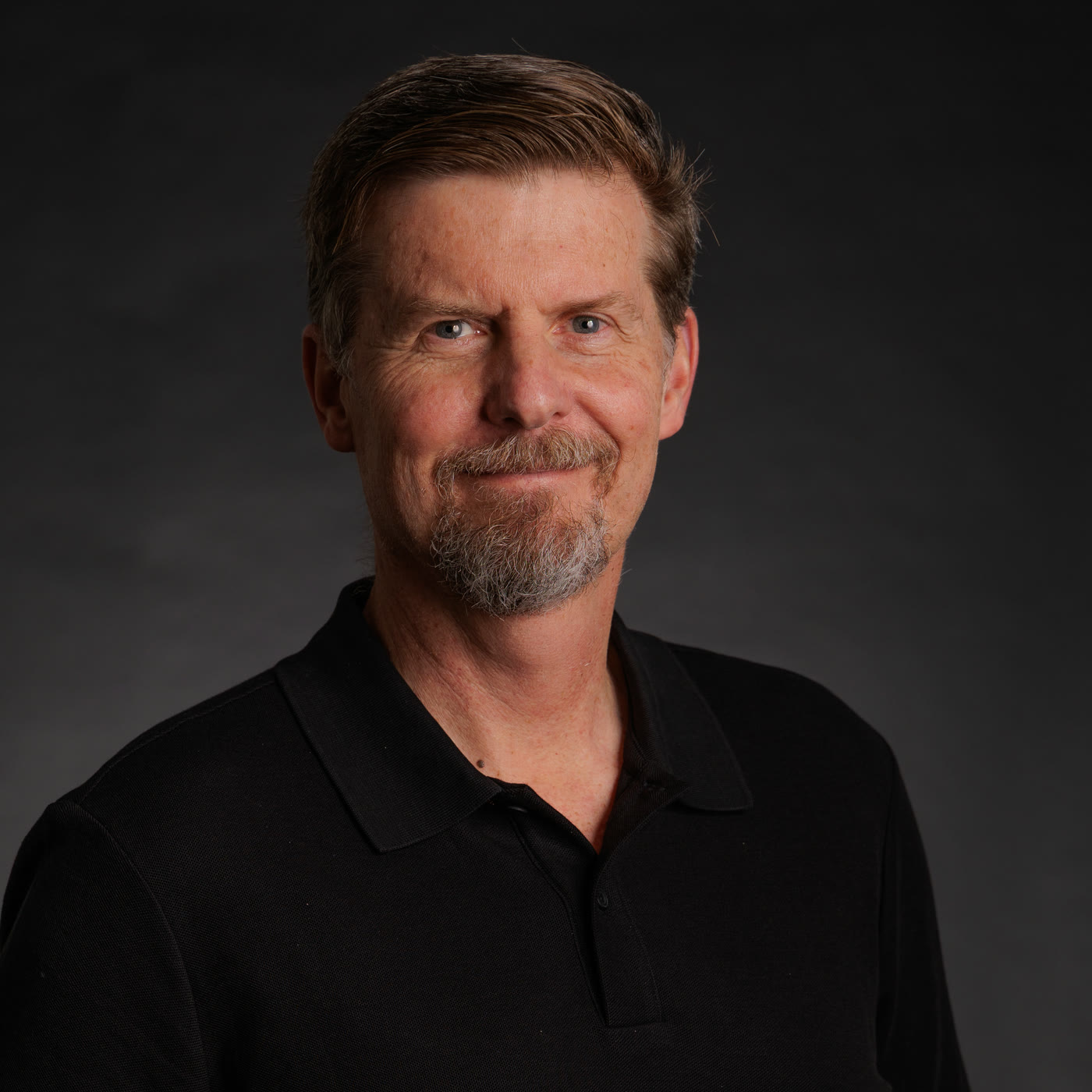
Stuart McClure, smiling, in a black polo shirt against a charcoal studio backdrop.

One Mission: Prevention

The story

Prologue

“People often ask me what drives me.

They see the companies, the books, the talks, and they try to connect the dots from a LinkedIn profile.

They see a career. But I don’t see a career.

I see a single, unbroken thread that runs from a childhood spent on the move for survival to a moment of sheer terror suspended 22,000 feet above the Pacific Ocean.

Everything I am, everything I’ve built and pursued, it all started there.

The truth is, all the dots connect back to a single, faulty latch.

But to understand the latch, you have to understand the kid who was conditioned to see it in the first place.”

Stuart McClure  ·  The Gift of a Second Chance

Stuart McClure

The Faulty Latch

A life spent preventing the next disaster

  1. IThe Observer
  2. IIThe Fall
  3. IIIThe Playbook
  4. IVThe Prediction
  5. VThe Human System
  6. VIYour Turn

Chapter one

The Observer

Guam · Hawaii · Colorado1970s–1985

“When you’re the new kid, over and over, you learn to do one thing really well: you watch.”

The Gift of a Second Chance

He grew up on Guam as a “haole” kid, a white outsider in a world that was Chamorro and Filipino. Being the new kid again and again, he learned to read every schoolyard before he stepped into it.

“I didn’t just see them playing; I saw the invisible architecture of their world.”

The Gift of a Second Chance
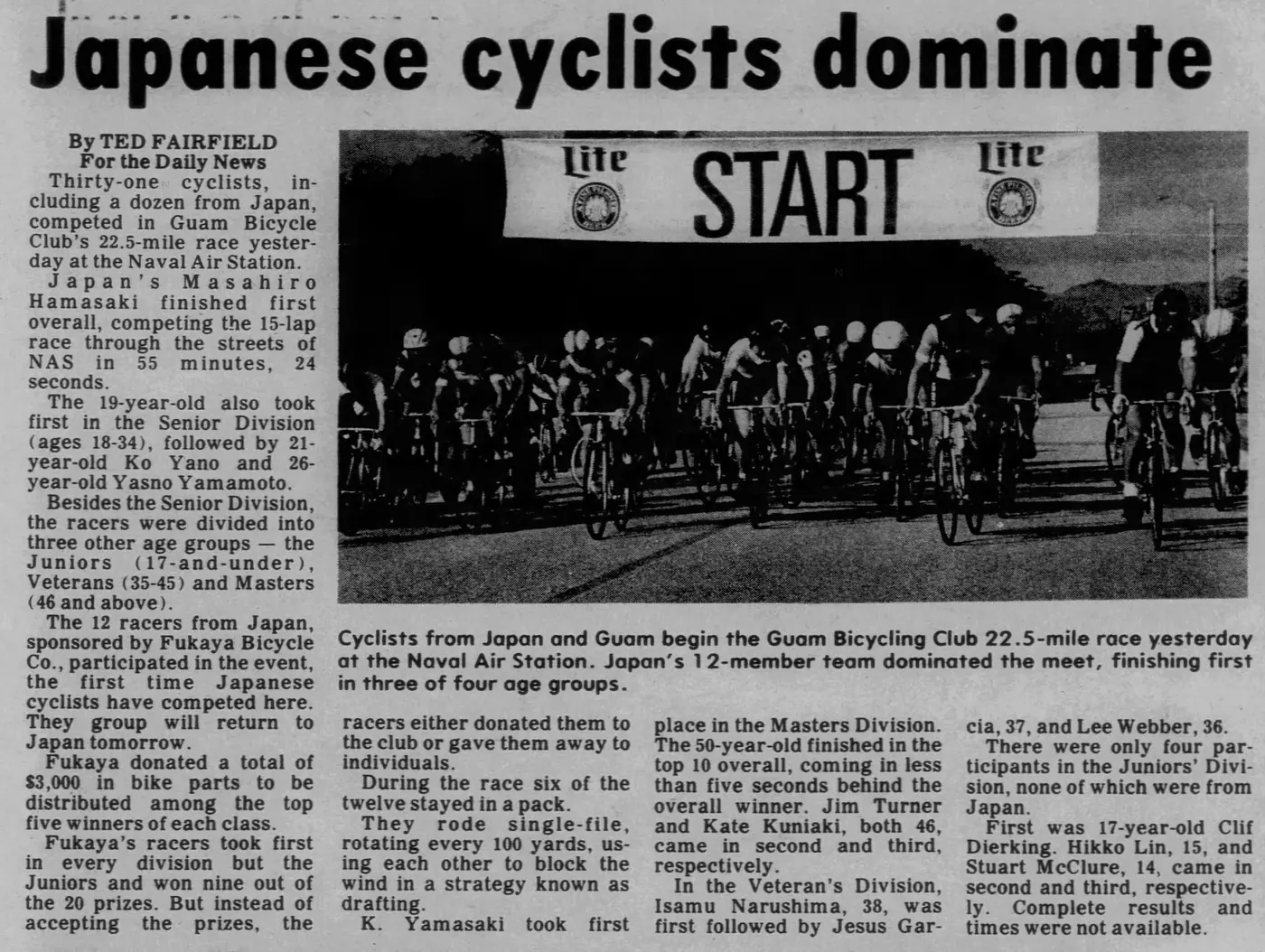
Newspaper clipping of a Guam Bicycle Club race start, with young riders lined up on the road.
The start of a Guam Bicycle Club race in the mid-1980s, from a Pacific Daily News clipping.
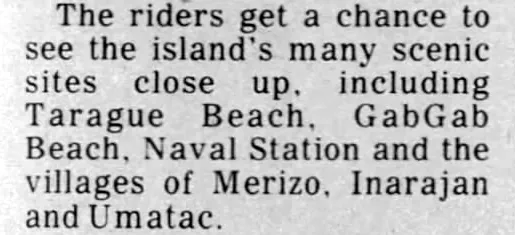
Guam in 1984: the places and club rides named in the Pacific Daily News of 18 April 1984, and his hill-climb win at Tarague that year A drawn map of the island of Guam, running north to south and narrowing at its waist near Agana (Hagåtña). It marks the places named in a Pacific Daily News article of Wednesday, 18 April 1984, about the Guam Bike Club: Tarague Beach in the north, Dededo, Agana (Hagåtña), Barrigada Hill, Nimitz Hill, GabGab Beach and the Naval Station on the harbor, Yona and Ipan on the east side, and the villages of Inarajan, Merizo and Umatac in the south. Two of that month's club rides are drawn as routes: the Merizo Fiesta Ride on 29 April, by way of Agana (Hagåtña), Sinajana, Yona, Ipan and Inarajan to Merizo, and the Hilly-Dilly Ride over Barrigada Hill, Government House and Nimitz Hill. Two places are marked as wins: the NAS track, where the same page reports that fifteen-year-old Stuart McClure won the club's 10-mile time trial at more than 20 miles per hour, and Tarague, where a 1984 results clipping lists him first in the junior class of the Tarague Challenge Hill Climb. The coastline and road shapes are simplified. Guam, 1984 From the Pacific Daily News Club rides that month Where he won Places the article names Merizo Fiesta Ride 29 April, by way of Agana (Hagåtña), Sinajana, Yona, Ipan and Inarajan 29 April Hilly-Dilly Ride Barrigada, Government House and Nimitz hills Barrigada Hill to Nimitz Hill Dededo Agana (Hagåtña) Barrigada Hill Nimitz Hill GabGab Beach Naval Station Yona Ipan Umatac Inarajan Merizo Tarague Beach Junior hill climb, first 1984 NAS track 10-mile time trial, first N 5 miles
Pacific Daily News clipping, 18 April 1984: “The riders get a chance to see the island’s many scenic sites close up, including Tarague Beach, GabGab Beach, Naval Station and the villages of Merizo, Inarajan and Umatac.”

The article lists where the club’s rides went: out to the beaches, the Naval Station and the villages of the south.
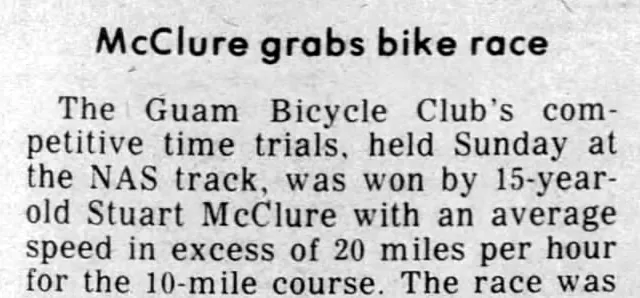
Pacific Daily News clipping headlined “McClure grabs bike race”: the Guam Bicycle Club’s time trials, held Sunday at the NAS track, were won by 15-year-old Stuart McClure at an average speed of more than 20 miles per hour for the 10-mile course.

On the same page: at fifteen, he won the club’s 10-mile time trial at the NAS track, averaging more than 20 miles per hour.

Results clipping from the Tarague Challenge Hill Climb: Junior (15–17), first place, Stuart McClure, 6:21.62.

At the Tarague Challenge Hill Climb in 1984 he was first among the juniors, ages 15 to 17, in 6:21.62.
In April 1984 the Guam Bike Club rode almost every weekend, and its riders saw the island up close, from Tarague Beach in the north to Merizo in the south. Stuart, fifteen, was one of the local teens on the club’s newly formed racing team. These are the places named in the Pacific Daily News of Wednesday, 18 April 1984 (page 39, “Cyclists do it for fun, fitness” and “McClure grabs bike race”). The 1984 hill-climb result comes from a clipping on the Endurance Cycling page. Coastline and roads are simplified.
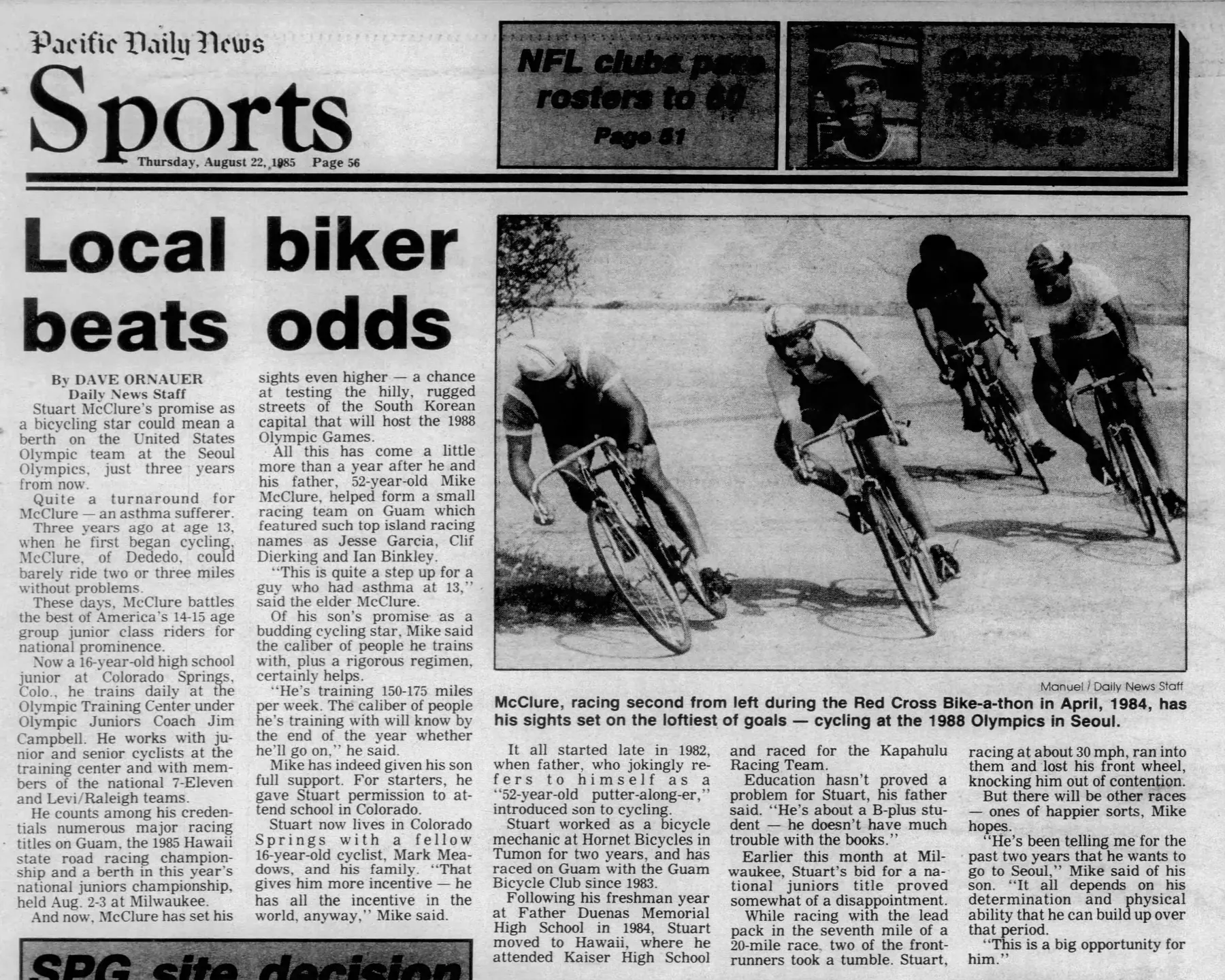
Pacific Daily News page from 22 August 1985, headlined 'Local biker beats odds', with a photograph of teenage Stuart McClure racing.
Pacific Daily News, 22 August 1985: “Local biker beats odds.”

The first thing he learned to prevent

At thirteen he had asthma. At sixteen he was training at the U.S. Olympic Training Center.

1982
His father, Mike, introduces him to cycling. At first he can “barely ride two or three miles without problems.”
1985
He wins the Hawaii state road-race championship. Then he goes to Colorado Springs to train every day, aiming for the 1988 Olympic Games in Seoul.

From the Pacific Daily News, 22 August 1985.

“I had no idea what the rules were. But I watched for an hour.… The next day, I walked up, and without saying a word, I played. And I fit in.”

The Gift of a Second Chance · on a game of marbles in Guam

Chapter two

The Fall

24 February 1989United Airlines Flight 811 · Honolulu to Sydney, via Auckland

What the record shows

  1. 01:52:49 HSTFlight 811 is cleared for takeoff from runway 8R at Honolulu.Aboard are 3 flight crew, 15 cabin crew and 337 passengers.
  2. 02:09:09 HSTThere is a loud bang as the forward cargo door separates from the airplane.It is still climbing, between 22,000 and 23,000 feet.
  3. 02:34 HSTThe airplane has landed back at Honolulu and stopped on the runway. The evacuation begins.

National Transportation Safety Board, Aircraft Accident Report NTSB/AAR-92/02.

“For twenty minutes, as the pilots wrestled with a crippled giant, trying to get us back to Honolulu, I was absolutely, fundamentally certain that I was going to die.”

The Gift of a Second Chance

Out from Honolulu, and back

The flight path of United Airlines Flight 811 on 24 February 1989: out from Honolulu, and back A schematic map. A small inset shows the planned route across the Pacific: from Honolulu to Auckland, New Zealand, and on to Sydney, Australia. The main map shows the island of Oahu and the ocean around it. Flight 811 was cleared for takeoff from Honolulu on runway 8R at 01:52 Honolulu time, with 355 people aboard. At 02:09, about sixteen minutes later, while the airplane was climbing between 22,000 and 23,000 feet, the forward cargo door separated. That point is marked in violet. The captain turned 180 degrees to the left and headed back to Honolulu; the way home is drawn in brass. By 02:34, about twenty-five minutes after the door separated, the airplane had landed, stopped on runway 8L at Honolulu, and the evacuation had begun. Nine passengers were lost. A time bar along the bottom shows the same three times to scale. The path over the water is schematic: the NTSB report records times and altitudes, not the track. Planned route Honolulu Auckland Sydney Oahu Honolulu 01:52 HST Cleared for takeoff 02:09 HST The forward cargo door separates climbing between 22,000 and 23,000 feet Turned 180° to the left Back to Honolulu 02:34 HST Stopped on runway 8L About 16 minutes About 25 minutes home 01:52 02:09 02:34

Where the door was

Where the forward cargo door is on a Boeing 747, seen from the right side and from above Two outline views of a Boeing 747 like the 747-122 that flew as Flight 811, drawn to approximate proportions. In the side view, seen from the right, the forward cargo door is outlined in violet low on the fuselage, ahead of the wing. It opened outward, and the door opening measured about 110 inches wide by 99 inches high along the fuselage. The aft cargo door, behind the wing on the same side, is drawn in neutral gray. The view from above shows the forward cargo door again on the right side of the fuselage and numbers the four engines: No. 1 and No. 2 under the left wing, No. 3 and No. 4 under the right wing. After the door separated, the crew shut down engines No. 3 and No. 4 and flew the final approach on No. 1 and No. 2, which are marked in brass. Seen from the right side Forward cargo door lower right side, about 110 by 99 inches Aft cargo door Seen from above No. 1 No. 2 No. 3 No. 4 Home on No. 1 and No. 2 No. 3 and No. 4 were shut down
Flight 811 was bound for Auckland and Sydney with 355 people aboard. About sixteen minutes after it was cleared for takeoff from Honolulu, while the airplane was still climbing, the forward cargo door on the lower right side of the fuselage separated. The captain turned back. Two engines on the right wing were shut down, and the crew brought the airplane home to Honolulu on the two on the left. Nine souls were lost. The track over the water is drawn schematically, because the report records times and altitudes rather than the path; the airplane is drawn to approximate proportions. Times are local Honolulu time (HST), as the report gives them. Source: National Transportation Safety Board, Aircraft Accident Report NTSB/AAR-92/02, §1.1 (history of the flight), §1.3 (damage to the airplane), §1.6.1 and §1.6.2 (the airplane and its cargo doors), §1.11 (flight recorders, for 02:09).

“It wasn’t like in the movies. There’s no dramatic music, no slow motion. It was a physical assault.”

The Gift of a Second Chance

“…he extended his hand to shake mine and said ‘It’s been nice knowing you.’”

Why Cylance? · 4 December 2012 · on the stranger across the aisle

“When we finally, miraculously, landed back in Honolulu, the silence was as shocking as the noise had been. The wind was gone.”

The Gift of a Second Chance

In memory of the nine

“One moment they were there, people with lives and families and plans, and the next, just a gaping hole and the deafening, soul-stealing roar of the wind.”

The Gift of a Second Chance

Nine passengers were lost. 346 of the 355 people aboard survived.

A latch failed.A door blew off.This didn’t have to happen.

Stuart McClure · The Gift of a Second Chance

There was time.

There was time: 717 days passed between the first warning and Flight 811.

Almost two years earlier, a Pan Am 747 had landed with its cargo door open. A fix was ordered, but on this airplane it was not scheduled until April 1989.

  1. 10 March 1987 · Day 0A Pan Am 747 returns to London with pressurization problems. On the ground, its forward cargo door is found open about 1½ inches. The latch cams are unlatched, yet the cockpit warning light is off.NTSB AAR-92/02, §1.17.1
  2. 8 April 1987Boeing issues Alert Service Bulletin 52A2206 on the cargo doors’ latch locking system.NTSB AAR-92/02
  3. 27 August 1987Boeing issues a second bulletin, 52A2209, on the same latch locking system.NTSB AAR-92/02
  4. 13 May 1988The FAA makes the fix mandatory in Airworthiness Directive 88-12-04, giving airlines 18 or 24 months to complete it.NTSB AAR-92/02, §1.6 (the analysis cites 1 July 1988)
  5. 24 February 1989 · Day 717United Airlines Flight 811.NTSB AAR-92/02
  6. April 1989The fix on this airplane was scheduled to be finished this month. The legal deadline was not until January 1990.NTSB AAR-92/02, §1.6.8

“The B-747 cargo door has eight (8) view ports located beneath the latch cams for direct viewing of the position of the cams by means of alignment stripes. Procedures for using these view ports for verifying the position of the cams were not in place or required by Boeing, the FAA, or UAL.”

National Transportation Safety Board · AAR-92/02

Prevention is rarely dramatic. It is someone checking in time.

The lesson in the evidence

The light measured the handle. Not the latch.

On the 1987 Pan Am flight, the cockpit told the crew the cargo door was secure. But the warning light was wired to the door’s handle and its relief doors, not to the latch cams that hold the door shut. Everything the crew could check from the cockpit said “closed,” while the latches themselves were open.

“Don’t trust us! Please, please, please, just trust yourself. Test for yourself.”

Stuart McClure · Know the Truth · 2016
What the cockpit checked The 747 cargo door with its lock handle stowed and both pressure relief doors closed. A wire runs from the relief doors to a cockpit warning light, which is off, so the cockpit reads the door as secure. Along the sill, all eight latch cams are open. Relief doors closed Lock handle stowed All 8 latch cams open Cargo door light off Cockpit: “secure”
Drawn after the NTSB report AAR-92/02, §1.17.1. On the 1987 Pan Am door, the handle was stowed and the relief doors were closed, so the warning light went out, even though the latch cams were still open.

What no one had to check

Eight small windows. One under each latch.

The door had a small window beneath every latch. Look through it and a painted stripe on the latch cam either points at an arrow, or it doesn’t. If it doesn’t, that latch is open. There is no wiring and no warning light to trust: you are looking at the latch itself.

In 1970 the FAA approved a simpler check, which was to look at the relief doors instead. After that, looking through the windows was no longer part of the procedure.

“Procedures for using these view ports for verifying the position of the cams were not in place or required by Boeing, the FAA, or UAL.”

National Transportation Safety Board · AAR-92/02, §1.6.2

On 31 March 1989, five weeks after Flight 811, an FAA emergency directive put the eight windows back into the procedure (§1.17.3). The circle with a level stripe that you see across this site is drawn from that check. When the stripe is in line, it means someone looked for themselves instead of assuming.

Looking through a view port Two magnified view ports. On the left the painted stripe on the latch cam points straight at the arrow on the fitting: the latch is closed. On the right the stripe is turned away from the arrow: the latch is open. In line: latched stripe meets the arrow Out of line: open as on the 1987 Pan Am door
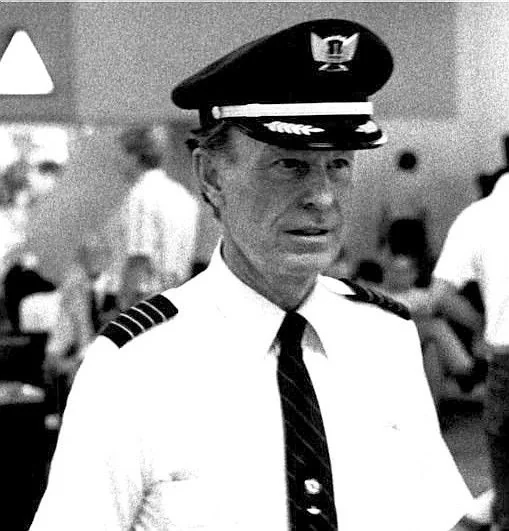
Black-and-white photograph of Captain David Cronin in his United Airlines uniform and cap.
Captain David Cronin, United Airlines Flight 811.

Months later, Stuart spoke with the captain, David Cronin, by phone, and asked how he got them home.

“I don’t know, Stuart.”

“…with well over 200 simulations modeled, they all crashed in the water or on land. So no, I truly don’t know how we all made it back.”

Captain David Cronin, as Stuart recalled him · Why Cylance? · 2012

In the captain’s telling, every one of those simulations ended in a crash. On the real flight, it was people, the crew in the cockpit, who brought everyone home.

Tragedy = Passion.

“I was given a present beyond words that day: a life’s passion. To find and fix the problems introduced by technology to prevent bad stuff from happening to innocent people.”

Why Cylance? · 4 December 2012

The full account of Flight 811, in his words

Chapter three

The Playbook

1996–2004InfoWorld · Hacking Exposed · Foundstone

“We had to get this knowledge out there, to democratize it, to arm the people on the front lines.”

The Gift of a Second Chance

Hacking Exposed, 1999–2012

“We weren’t giving away secrets; we were arming our own side.”

The Gift of a Second Chance

Stuart wrote the book with Joel Scambray and George Kurtz. It laid out, step by step, how attackers break into computer systems, so that the people defending those systems could see what was coming and stop it.

“Every copy we sold felt like installing a stronger latch somewhere in the world.”

The Gift of a Second Chance
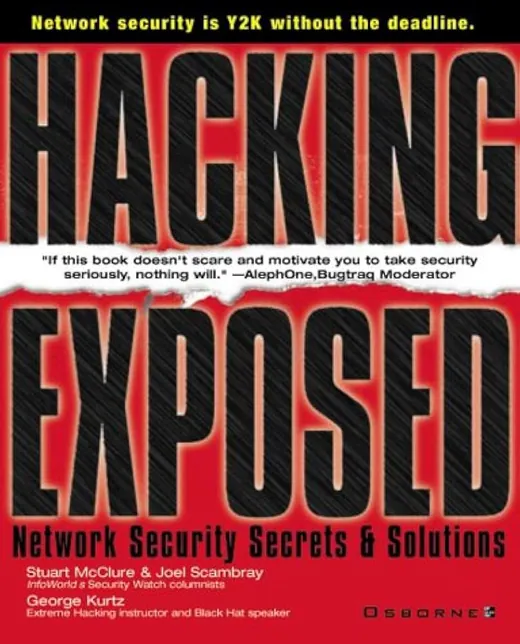
Hacking Exposed, first edition cover Hacking Exposed, second edition cover Hacking Exposed, third edition cover Hacking Exposed, fourth edition cover Hacking Exposed, fifth edition cover Hacking Exposed, sixth edition cover Hacking Exposed, seventh edition cover

The shelf

The playbook kept growing.

Stuart McClure’s books and forewords, in year orderA bookshelf that fills in year order, from 1999 to 2026. The books Stuart McClure wrote or co-wrote: Hacking Exposed, 1st edition (1999); the 2nd edition (2000); the 3rd edition (2001); Hacking Exposed Windows 2000 (2001); Hacking Exposed, 4th edition (2003); Web Hacking: Attacks and Defense, with Saumil Shah and Shreeraj Shah (2002); Hacking Exposed, 5th edition (2005); Hacking Exposed Windows Server 2003 (2006); Hacking Exposed Windows, 3rd edition (2007); Hacking Exposed, 6th edition (2009); Hacking Exposed, 7th edition (2012); and Guardians of the Machine Age: Security in the Digital Era, a multi-author volume he contributed to (2026). The Hacking Exposed spines share one look, black with brass bands, and the Windows volumes add a blue band. Set apart at the end of the shelf, in slimmer spines, are the forewords he wrote for other authors’ books: Special Ops: Host and Network Security for Microsoft, Unix, and Oracle by Erik Pace Birkholz (2003); Hacking for Dummies by Kevin Beaver (2004); Sockets, Shellcode, Porting & Coding (2005); How to Measure Anything in Cybersecurity Risk by Douglas Hubbard and Richard Seiersen (2016); Introduction to Artificial Intelligence for Security Professionals by the Cylance team (2018); and The Language of Deception by Justin Hutchens (2024).Books he wrote, co-wrote or contributed toForewords Books he wrote, co-wrote or contributed toForewords
How a Hacking Exposed chapter teaches A simplified open book, not a real page. The left page shows an attack laid out step by step. An arrow crosses the gutter to the right page, which holds the countermeasures that address it, marked with a level brass stripe, the site’s sign for checked and secure. 1 2 3 The attack, shown step by step The countermeasures that address it

Every attack chapter of Hacking Exposed follows the same pattern. First it shows how an attack works, in enough detail to repeat it. Then it gives the countermeasures that address it.

“…we painstakingly enumerate the ways the hacker gains access to systems, networks, applications and databases… And we went to great lengths to discuss the fixes, changes, products, education and mitigating countermeasures that would reduce and eliminate the risks found in the book.”

Why Cylance? (Part 2) · 13 February 2013
Titles and years come from the Library on this site; Web Hacking’s co-authors are from its book page. The spines are drawn for this page and are not the real cover designs. The chapter pattern is described on the old site’s pages for the fifth and sixth editions, and by Stuart in Why Cylance? (Part 2), 2013.
Arrow keys move the lens when the scan is focused.

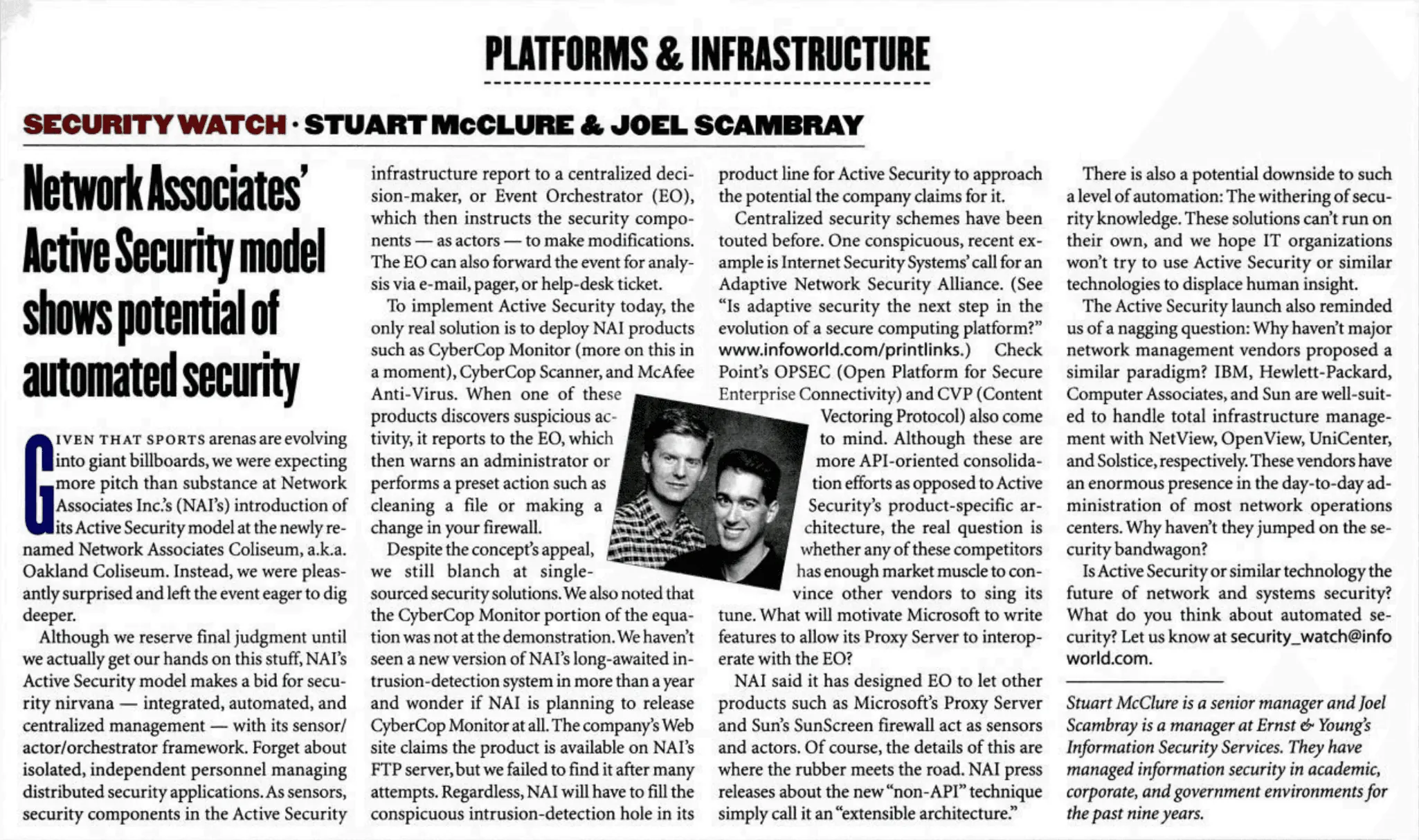
From his Security Watch column in InfoWorld

He said it in 1999.

“…we hope IT organizations won’t try to use Active Security or similar technologies to displace human insight.”

InfoWorld · 19 April 1999 · Stuart McClure & Joel Scambray

“…customers realize that prevention, and not simply detection, is key to thwarting attackers.”

InfoWorld · 27 Dec 1999 / 3 Jan 2000 · Stuart McClure & Joel Scambray
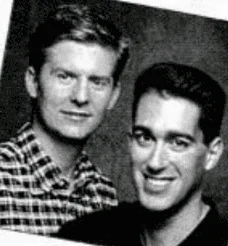
Newsprint photograph of Stuart McClure and Joel Scambray from their 1999 InfoWorld column.
Stuart McClure and Joel Scambray in 1999. Together they wrote ninety-two Security Watch columns for InfoWorld between 1998 and 2002.

Chapter four

The Prediction

2012–2019Cylance

“I didn’t want to detect attacks faster; I wanted to prevent them from ever executing in the first place.”

The Gift of a Second Chance

Cylance headquarters, Irvine, California.

A latch the way it is meant to be: the cam closed around its pin and the lock sector locked over it A close-up of one cargo-door latch, drawn after Figure 5 of the NTSB report AAR-92/02. The latch cam is closed around its pin, and its painted alignment stripe points straight at the arrow on the fitting below, which is how someone looking through the view port could see that it was latched. Above it, the brass lock sector has rotated down into its locked position over the cam. Lock sector locked Pin Latch cam closed The stripe meets the arrow
A latch cam closed around its pin, with the lock sector locked over it: the way the latch is meant to be. Drawn after the NTSB report AAR-92/02, Figure 5.

The latch, again

“It was the digital equivalent of an engineer inspecting the cargo door latch and knowing, just by its metallurgical properties and design, that it was going to fail under pressure, without ever having to see it fail first.”

The Gift of a Second Chance · on Cylance’s AI

Two ways to meet a new file

Two ways to meet a new file: signature antivirus and prediction Two timelines side by side, with time running down the page. On the left is signature antivirus. A new file arrives and no signature matches it, because it is new, so it runs and someone is hit first. Only then is a sample caught and analyzed, a signature made, and an update shipped out to millions of machines. You are protected after the fact. On the right is prediction, the approach Stuart McClure built at Cylance. The same new file arrives, a machine learning model reads it on the device and scores it in milliseconds, and the file is stopped before it can run, so you are protected and nothing ran. A dashed line across both timelines marks the moment the file would run. Signature antivirus After they get in. Prediction Before they get in. Where it would run A new file arrives. Nothing matches it.It is brand new. It runs.Someone is hit first. A sample is caught. It is analyzed. A signature is made. An update shipsout to millions. Now you’re protected,after the fact. A new file arrives. A model reads iton the device. It scores the filein milliseconds. Stoppedbefore it can run. You’re protected,and nothing ran.

Nine US patents, by the year each was granted

Stuart McClure’s nine US patents, grouped by family and placed by the year each was granted A time axis from 2006 to 2024 with three branches. First, network vulnerability detection and reporting, from Foundstone and later assigned to McAfee: five grants, US 7,152,105 in December 2006, US 8,135,830 in March 2012, and US 8,615,582, US 8,621,060 and US 8,621,073 in December 2013. Second, network-based asset operational dependence scoring, a McAfee patent: one grant, US 8,997,234 in March 2015. Third, machine learning at Cylance: application execution control utilizing ensemble machine learning, US 10,235,518 in March 2019 and its continuation US 10,817,599 in October 2020, and automated generative multimodel multiclass classification using machine learning, US 11,657,317 in May 2023. 2006 2010 2015 2020 Network vulnerability detectionFoundstone, later McAfee · five grants Asset dependence scoringMcAfee · one grant Machine learning that judges filesCylance · three grants

Signature antivirus looks for threats it already knows. For every new threat, Stuart wrote, a security company had to capture it, analyze it, create a signature, and push that update out to millions of machines. Cylance’s model did not wait: It made its decision pre-execution, in milliseconds, right on the endpoint. The Gift of a Second Chance; headings after Why Cylance? (Part 2), 2013

His nine US patents, from the Library: five on network vulnerability detection and reporting (Foundstone, later McAfee, 2006 to 2013), one on asset dependence scoring (McAfee, 2015), and three on machine learning that judges whether a file is safe to run (Cylance, 2019 to 2023). Each dot sits at the date the patent was granted. Library, U.S. patent records

His guiding question

“How do we stop the problem before it starts?”

The Gift of a Second Chance

2012 Co-founded Cylance

Cylance used artificial intelligence to judge whether a file was safe before it was allowed to run, right on the computer itself, instead of waiting for someone to be hit first.

House Oversight report, 2016
“The significance of the cutting edge preventative technology offered by Cylance in responding to the OPM data breach cannot be overstated.”
House Committee on Oversight and Government Reform, majority staff report, “The OPM Data Breach” · 7 Sep 2016 · p.123
2019 Acquired by BlackBerry for $1.5 billion

The deal was announced in November 2018 and closed in February 2019.

Chapter five

The Human System

2020–nowQwiet AI · NumberOne AI · WethosAI

“The most complex, volatile, and critical system of all is not made of code or silicon. It’s us. It’s the human system.”

The Gift of a Second Chance
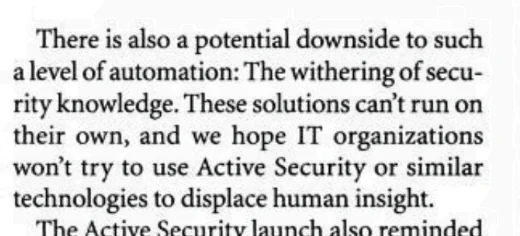
Scanned InfoWorld paragraph, 1999: 'There is also a potential downside to such a level of automation: The withering of security knowledge. These solutions can't run on their own, and we hope IT organizations won't try to use Active Security or similar technologies to displace human insight.'
From his InfoWorld column of 19 April 1999, written with Joel Scambray.

“Data doesn’t make decisions. People do.”

(un)Lonely at the Top · 17 August 2026

The companies, in their own words

The Human Context Platform

“Bring human alignment into the decisions that matter.”

CEO & co-founder · wethos.ai

A venture studio for applied AI

“…a venture studio and incubator creating intelligent systems that bridge research and reality.”

Founder · numberone.ai

Application security, built in

An AI-powered platform for application security, which helps teams keep the software they build safe from attack. Harness acquired Qwiet AI in 2025.

Former CEO

“This isn’t about replacing us; it’s about amplifying us.”

Human+AI Alignment · (un)Lonely at the Top · 17 September 2026

“WethosAI supports judgment. It does not replace it.”

Stuart McClure · founder’s letter, wethos.ai
A real decision A card holds a real question a leader might face: should we launch the new product in March, or wait until we fix onboarding? Below it are the two options, A: launch in March, and B: fix onboarding first. Option A is the one taken into rehearsal first. The decision before it becomes irreversible The question on the table Should we launch the new product in March, or wait until we fix onboarding? A Launch in March B Fix onboarding first Option A goes to rehearsal first, with the people it affects.
Rehearsing the decision with the people it affects Four people sit around a round table, each with the way they tend to decide: an engineering lead decides on the details, a sales lead on momentum, a support lead for the customer, and a finance lead on the risk. Option A, launch in March, travels once around the table and is tried against each of them. Engineering, sales and finance are in line with it. Support sees friction, because onboarding is not fixed yet, and that shows up before anything is decided. The four people are an illustration, not a real team. Rehearsing option A Launch in March EngineeringDecides on the details SalesDecides on momentum SupportDecides for the customer FinanceDecides on the risk Sees friction here
The leader decides The leader makes the call, now with the people it affects in view. The leader's portrait ring and the decision card settle in brass, marking the call as made. Beneath it: Human plus AI is greater than AI. The AI helps rehearse the decision; the person keeps the authority and the accountability for it. You decide with more of the room in view Your call, made with the people it affects in view Human + AI > AI Human + AI is greater than AI
The idea behind WethosAI, the company Stuart co-founded and leads as CEO: model how the people around a decision think and decide, so a leader can rehearse a consequential choice with human context before it becomes irreversible. Friction can surface before it becomes expensive, and authority and accountability stay with people. The example decision and the four people are illustrations, not a customer story or a product screen. Sources: Stuart’s founder letter on wethos.ai/company, his speaker bio, the WethosAI Manifesto, and his essay Human + AI is Greater Than AI.

Try it

One decision, human first.

Use AI the way Stuart builds it: to widen what you can see, not to make the call for you.

Everything here was written in advance; none of it is generated live. This page runs no AI model, and nothing you type leaves this page.

  1. Leave out private details, because you’ll paste this into another tool.

  2. Take this prompt to the AI tool you already use


  3. Check what the AI can’t know

  4. Make the call

    “Data doesn’t make decisions. People do.”

    Stuart McClure · (un)Lonely at the Top · 17 August 2026

    Your call. That’s the point.

Chapter six

Your turn.

The photo above shows Stuart at a UC Irvine commencement ceremony.

Your checks

Six small checks. No score.

Each of these takes only a few minutes. Open the ones you’ll actually do, and you can print them on a small card to keep in your wallet. Nothing you choose here is scored, saved or sent anywhere.

  • Agree on one word that only your family knows. If someone who sounds like a loved one calls in a panic asking for money, ask them for the word. AI can copy a person’s voice, but it can’t know what was said around your kitchen table.

  • Before you share something an AI told you, open at least one of its original sources and check that it really says that. As Stuart wrote in 2016: Test for yourself.

  • A backup only counts once you know you can get a file back from it. This week, try restoring one file from yours.

  • Whoever controls your email can reset the passwords on almost every other account you have. Protect it first, with a passkey or at least two-factor sign-in.

  • Scammers rely on urgency, because people in a hurry skip their usual checks. When a message says it’s urgent, wait a minute, then confirm it with the sender some other way, such as a phone number you already have.

  • Before the team commits, ask the room: “It’s next month and this failed. Why?” Then take the first answer seriously and fix it before you go ahead.

This prints the checks you opened, or all six if you haven’t opened any.

The film

The whole story, in sixty-eight seconds.

The record

The Faulty Latch

Founded

  • Computerese1992
  • Foundstone co-founder1999
  • Cylance co-founder & CEO2012
  • NumberOne AI2021/22
  • WethosAI co-founder & CEO2024

Led

  • McAfee Worldwide CTOto 2012
  • Qwiet AI CEOto 2025

Written

  • Hacking Exposed with Joel Scambray & George Kurtz1999–2012
  • Hacking Exposed Windows with Joel Scambray2001–2007
  • Web Hacking: Attacks and Defense with Saumil Shah & Shreeraj Shah2002
  • Guardians of the Machine Age contributing author2026
  • Forewords 6 books by other authors2003–2024
  • InfoWorld 40 articles · 92 Security Watch columns1996–2002

The numbers

  • Patents9
  • Board seats16
  • Exits, as founder, leader, board member or investor9
  • Years working in technology35+

Giving

  • Clavis Foundation “clavis” is Latin for key2020–
  • Omada Foundation community initiatives in Orange County

Every dated piece of work in the Library, year by year, from 1989 to 2026.

The Library, year by year, 1989 to 2026 A river chart of the 424 dated pieces of work in Stuart McClure’s Library, stacked by kind for each year from 1989 to 2026. It starts in 1989 with Flight 811. From 1996 to 2000 the river is almost all writing for InfoWorld and is widest in 2000, with 45 pieces. It runs thin from 2001 to 2011, widens again from 2012 with talks and press, and swells to 34 pieces in 2024, with talks the largest part. By kind: writing (169); talks (99); press (78); recognition (26); books and forewords (19); companies, boards and investments (24); about Flight 811 (14). Bands alongside the timeline show the companies he founded or co-founded: Computerese, 1992 to 1994; Foundstone, 1999 to 2004; Cylance, 2012 to 2019; NumberOne AI, 2022 to now; WethosAI, 2024 to now. Other bands show the ones he led: McAfee, 2004 to 2012; Qwiet AI, 2020 to 2025. A shelf of book spines holds one for each book he wrote, co-wrote or contributed to (published in 1999, 2000, 2001, 2002, 2003, 2005, 2006, 2007, 2009, 2012, 2026), including the first Hacking Exposed in 1999 and Web Hacking: Attacks and Defense, and a smaller, outlined spine for each foreword he wrote (2003, 2004, 2005, 2016, 2018, 2024). 1989 1995 2000 2005 2010 2015 2020 2026 Talks Writing Flight 811 February 1989 Hacking Exposed - 1st Edition (1999)Hacking Exposed - 2nd Edition (2000)Hacking Exposed - 3rd Edition (2001)Hacking Exposed Windows - 2000 Edition (2001)Web Hacking: Attacks and Defense (2002)Hacking Exposed - 4th Edition (2003)Special Ops: Host and Network Security for Microsoft, Unix, and Oracle (2003), forewordHacking for Dummies (2004), forewordHacking Exposed - 5th Edition (2005)Sockets, Shellcode, Porting & Coding (2005), forewordHacking Exposed Windows - Server 2003 Edition (2006)Hacking Exposed Windows - 3rd Edition (2007)Hacking Exposed - 6th Edition (2009)Hacking Exposed - 7th Edition (2012)How to Measure Anything in Cybersecurity Risk (2016), forewordIntroduction to Artificial Intelligence for Security Professionals (2018), forewordThe Language of Deception (2024), forewordGuardians of the Machine Age: Security in the Digital Era (2026) Computerese, 1992 to 1994ComputereseFoundstone, 1999 to 2004FoundstoneMcAfee, 2004 to 2012McAfeeCylance, 2012 to 2019CylanceQwiet AI, 2020 to 2025Qwiet AINumberOne AI, 2022 to nowNumberOne AIWethosAI, 2024 to nowWethosAI Hacking Exposed Web Hacking 1989: 2 pieces (2 about Flight 811)1990: no dated pieces1991: no dated pieces1992: 2 pieces (1 company, board or investment, 1 about Flight 811)1993: no dated pieces1994: no dated pieces1995: no dated pieces1996: 6 pieces (6 writing)1997: 16 pieces (16 writing)1998: 37 pieces (37 writing)1999: 36 pieces (33 writing, 1 press, 1 book or foreword, 1 company, board or investment)2000: 45 pieces (37 writing, 3 talks, 4 press, 1 book or foreword)2001: 6 pieces (2 writing, 2 talks, 2 books or forewords)2002: 3 pieces (1 writing, 1 press, 1 book or foreword)2003: 4 pieces (1 talk, 1 press, 2 books or forewords)2004: 5 pieces (1 talk, 2 press, 1 book or foreword, 1 company, board or investment)2005: 4 pieces (2 press, 2 books or forewords)2006: 3 pieces (1 press, 1 recognition, 1 book or foreword)2007: 1 piece (1 book or foreword)2008: no dated pieces2009: 3 pieces (1 press, 1 book or foreword, 1 about Flight 811)2010: no dated pieces2011: 5 pieces (1 talk, 4 press)2012: 13 pieces (1 writing, 2 talks, 4 press, 3 recognition, 1 book or foreword, 2 companies, boards or investments)2013: 15 pieces (2 writing, 4 talks, 6 press, 3 recognition)2014: 14 pieces (6 writing, 4 talks, 3 press, 1 company, board or investment)2015: 16 pieces (6 writing, 4 talks, 3 press, 1 recognition, 2 companies, boards or investments)2016: 26 pieces (4 writing, 9 talks, 8 press, 3 recognition, 1 book or foreword, 1 about Flight 811)2017: 18 pieces (1 writing, 9 talks, 2 press, 3 recognition, 2 companies, boards or investments, 1 about Flight 811)2018: 11 pieces (4 talks, 4 press, 1 recognition, 1 book or foreword, 1 about Flight 811)2019: 18 pieces (6 talks, 8 press, 2 recognition, 1 company, board or investment, 1 about Flight 811)2020: 6 pieces (1 talk, 1 press, 1 recognition, 3 companies, boards or investments)2021: 4 pieces (2 talks, 1 recognition, 1 company, board or investment)2022: 7 pieces (1 talk, 4 press, 2 companies, boards or investments)2023: 21 pieces (13 talks, 4 press, 1 recognition, 2 companies, boards or investments, 1 about Flight 811)2024: 34 pieces (5 writing, 14 talks, 7 press, 4 recognition, 1 book or foreword, 3 companies, boards or investments)2025: 25 pieces (10 writing, 8 talks, 3 press, 1 company, board or investment, 3 about Flight 811)2026: 18 pieces (2 writing, 10 talks, 1 press, 1 recognition, 1 book or foreword, 1 company, board or investment, 2 about Flight 811) The Library, year by year, 1989 to 2026 A river chart of the 424 dated pieces of work in Stuart McClure’s Library, stacked by kind for each year from 1989 to 2026. It starts in 1989 with Flight 811. From 1996 to 2000 the river is almost all writing for InfoWorld and is widest in 2000, with 45 pieces. It runs thin from 2001 to 2011, widens again from 2012 with talks and press, and swells to 34 pieces in 2024, with talks the largest part. By kind: writing (169); talks (99); press (78); recognition (26); books and forewords (19); companies, boards and investments (24); about Flight 811 (14). Bands alongside the timeline show the companies he founded or co-founded: Computerese, 1992 to 1994; Foundstone, 1999 to 2004; Cylance, 2012 to 2019; NumberOne AI, 2022 to now; WethosAI, 2024 to now. Other bands show the ones he led: McAfee, 2004 to 2012; Qwiet AI, 2020 to 2025. A shelf of book spines holds one for each book he wrote, co-wrote or contributed to (published in 1999, 2000, 2001, 2002, 2003, 2005, 2006, 2007, 2009, 2012, 2026), including the first Hacking Exposed in 1999 and Web Hacking: Attacks and Defense, and a smaller, outlined spine for each foreword he wrote (2003, 2004, 2005, 2016, 2018, 2024). 1989 1995 2000 2005 2010 2015 2020 2026 Writing Computerese, 1992 to 1994Foundstone, 1999 to 2004McAfee, 2004 to 2012Cylance, 2012 to 2019Qwiet AI, 2020 to 2025NumberOne AI, 2022 to nowWethosAI, 2024 to now Flight 811, 1989ComputereseFoundstoneHacking ExposedWeb HackingMcAfeeCylanceQwiet AINumberOne AIWethosAI
  • Writing 169
  • Talks 99
  • Press 78
  • Recognition 26
  • Books and forewords 19
  • Companies, boards and investments 24
  • About Flight 811 14
  • Founded or co-founded
  • Led
  • Book he wrote, co-wrote or contributed to
  • Foreword he wrote
The numbers, year by year
Pieces of work in the Library per year, by kind. Years with no pieces are left out.
YearWritingTalksPressRecognitionBooks and forewordsCompanies, boards and investmentsFlight 811All
198900000022
199200000112
199660000006
19971600000016
19983700000037
19993301011036
20003734010045
200122002006
200210101003
200301102004
200401201105
200500202004
200600111003
200700001001
200900101013
201101400005
2012124312013
2013246300015
2014643001014
2015643102016
2016498310126
2017192302118
2018044110111
2019068201118
202001110306
202102010104
202201400207
20230134102121
20245147413034
20251083001325
20262101111218
No year00311005
All169997826192414429
This chart is drawn from the Library itself, so it grows whenever the Library does. The Library holds 429 pieces of work; the 424 that carry a year are shown here, and five undated pieces are counted in the totals but not in the river. The river is widest from 1998 to 2000, when the InfoWorld articles and Security Watch columns were coming out, and it swells again from 2023 with podcasts, webinars and keynotes. Among the book spines is Web Hacking: Attacks and Defense, alongside the Hacking Exposed books, and the outlined spines are the forewords he wrote for other authors’ books. Source: the Library on this site.

In memory of the nine passengers of United Airlines Flight 811 who did not come home.24 February 1989

Founder Film · 1:08

On-screen text (the film has no narration)
  1. February 24, 1989 · United 811 · Honolulu → Auckland
  2. At 22,000 feet, the forward cargo door tore away.
  3. “It’s been nice knowing you.” — A stranger across the aisle, shaking his hand · Row 41
  4. Nine people died. 328 passengers and 18 crew survived.
  5. “The airline industry knew about the door latching problem... but chose not to fix it.” — Stuart McClure, Why Cylance? 2012
  6. Stuart McClure · Founder & CEO · WethosAI · NumberOne AI
  7. “Tragedy = Passion.”
  8. “I was given a present beyond words that day: a life’s passion. To find and fix the problems introduced by technology, to prevent bad stuff from happening to innocent people.”
  9. 01 — 1999 · Hacking Exposed. He published the attackers’ playbook. For the defenders.
  10. #1 security book in history · 1,000,000+ copies · 8 editions
  11. “We know the techniques of the hacker. We even know how to stop them. But we don’t do it.”
  12. 02 — 1999–2012 · Foundstone + McAfee. Co-founded Foundstone. Acquired by McAfee. Became its Global CTO.
  13. 03 — 2012 · Cylance. The first AI to stop malware before it ran.
  14. “We CAN stop them BEFORE they get in.”
  15. $1.5B acquisition · Fastest to $100M ARR in cybersecurity history · 3.25 years
  16. Then he noticed where the most destructive failures actually start.
  17. People.
  18. 04 — 2024 · WethosAI. “Well over 200 simulations modeled — they all crashed.” — Captain David Cronin, to Stuart, on Flight 811’s landing
  19. Today he builds the simulation you run before it’s real. See how the decision lands before you make it.
  20. 35+ years in tech · 5 companies founded · 9 exits · 9 patents · 12 books · 16 board seats · EY Entrepreneur of the Year 2016 · Hacking Exposed: 1M+ copies · Cylance: $1.5B
  21. Find the faulty latch. Before it fails.
  22. Guardians of the Machine Age: The Gift of a Second Chance · A memoir · March 2026 · stuartmcclure.ai · Predict · Prevent · Locked

You’re leaving stuartmcclure.ai

Try Stu’s Twin on wethos.ai

An AI model of how Stuart thinks, built and run by WethosAI, the company Stuart co-founded and leads as CEO. In WethosAI’s words: You’re interacting with Stu’s AI Twin, not Stu live.

Its answers come from the model, not from Stuart, and he hasn’t reviewed them in advance. WethosAI’s own privacy terms apply there.

Continue to wethos.ai ↗